

The Mawalis: Inside the World of the Sundarban Honey Collectors

The Mawalis: Inside the World of the Sundarban Honey Collectors
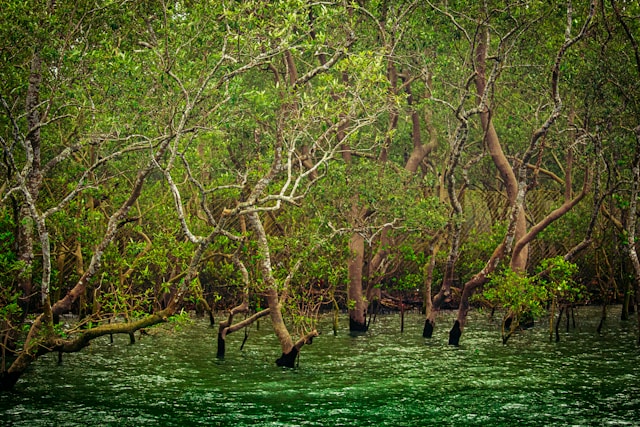
The Sundarbans, a vast, tangled delta of mangrove forests where India meets Bangladesh, is a land defined by water, mud, and a persistent, primal danger. Here, among the breathing roots and tidal creeks, resides a unique, enduring culture of survival. This is the realm of the Mawalis, the legendary Sundarban honey collectors, whose profession is arguably one of the most iconic—and perilous—in the world.
Table of Contents
Who Are the Mawalis?
The Mawalis are a community of forest-dwellers whose livelihood is entirely dependent on the forest’s sweet, dangerous bounty: the wild honey of the Apis dorsata (the giant rock bee). Historically, they are a testament to human adaptation, living in harmony with one of the most hostile natural environments on earth.
Each year, between April and June, they embark on the great honey harvest, a tradition passed down through generations. Their role is not merely economic; it is a cultural anchor, connecting them to the very soul of the Sundarbans. They are the keepers of the forest’s sweetest secret and the embodiment of its risks.
The Ritual of Bonbibi: Seeking Divine Protection
No journey into the treacherous Sundarbans is undertaken lightly, and for the Mawali Sundarban, preparation is as much spiritual as it is practical. Before their boats push off into the tidal labyrinth, the Mawalis perform a solemn ritual dedicated to Bonbibi, the benevolent forest goddess.
Bonbibi is the protector of the forest and its people, a divine figure who keeps the dreaded tiger god, Dakshin Rai, at bay. The Mawalis believe that without Bonbibi’s grace, they are merely prey.
Offerings of sweets and flowers are made, and prayers are chanted, asking for safe passage and a bountiful harvest. They enter the forest not as conquerors, but as humble guests, seeking permission from its divine guardian.
This act underscores their deep respect for the ecosystem and their acknowledgment that their lives depend on powers greater than themselves.
Into the Mangrove Labyrinth
The hunt for Sundarban wild honey is a grueling, silent process. The Mawalis, often working in small groups, navigate the dense, muddy landscape, guided by an almost supernatural instinct.
They follow the flight patterns of the bees, listen for the tell-tale hum of a large colony, and watch for subtle signs of bee activity.
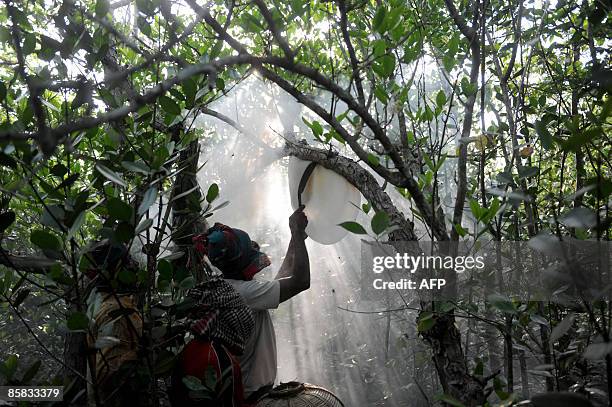
Once a giant hive is located, often hanging precariously from a tall Keora or Goran tree, the extraction begins. Using techniques unchanged for centuries, a Mawali will climb the tree while others gather dried leaves and twigs.
A small fire is lit, and the smoke is carefully directed toward the hive. This smoke doesn’t kill the bees; it disorients them, making them less aggressive. The collector then uses a sturdy, sharp knife to cut away the honeycombs, lowering the dripping, golden treasure into a bucket or basket with a rope.
It is a precise art that requires immense courage, agility, and a profound respect for the bees, ensuring enough comb is left intact for the colony to rebuild.
The Constant Threat of the Tiger
The true drama of the Mawali’s life is the constant, unseen danger that stalks them. The Sundarbans is home to the Royal Bengal Tiger, a magnificent apex predator uniquely adapted to swim in the brackish water and hide among the dense roots.
The Mawalis are acutely aware that they are entering the tiger’s domain. Every rustle in the undergrowth, every snapped twig, sends a jolt of primal fear.
They often wear masks on the backs of their heads, hoping to deter a tiger’s ambush—a tiger typically attacks from behind.
Beyond the tiger, the Mawalis face venomous snakes, crocodiles lurking in the mud, and the sheer exhaustion of navigating a difficult environment with minimal supplies. Their life is a high-stakes gamble against nature, where the sweet taste of success is constantly shadowed by the bitter possibility of tragedy.
The Sweet Reward: Economy and Culture
Upon their return, the Mawalis bring with them what is widely regarded as some of the purest, most medicinal honey in the world.
Sundarban honey has a unique flavor profile, derived from the diverse mangrove flowers, and is prized for its organic quality.
This honey is not just a commodity; it is the currency of their survival, providing the meager income needed for the rest of the year.
The Mawalis’ tale is a powerful cultural narrative of interdependence, risk, and ritual. For those who seek to understand the beating heart of the Sundarbans, the Mawalis are essential viewing.
Take A Boat and the Mawali Legacy
At Take A Boat, we deeply respect the traditions and immense risks undertaken by the Sundarban honey collectors.
Our commitment to responsible tourism means that while our tours explore the beauty of the Sundarbans, we maintain a respectful distance from the Mawalis' process.
We seek to educate our guests on their vital cultural role. On occasion, Take A Boat may facilitate opportunities to learn about this unique tradition and, sometimes, purchase authentic, responsibly sourced wild honey directly from the communities—ensuring that your support goes straight to these brave forest guardians without interfering with their ancient harvest.
The Mawalis’ story is one of enduring human spirit—a mesmerizing chapter in the wild book of the Sundarbans. Their sacrifice is our sweet reward.